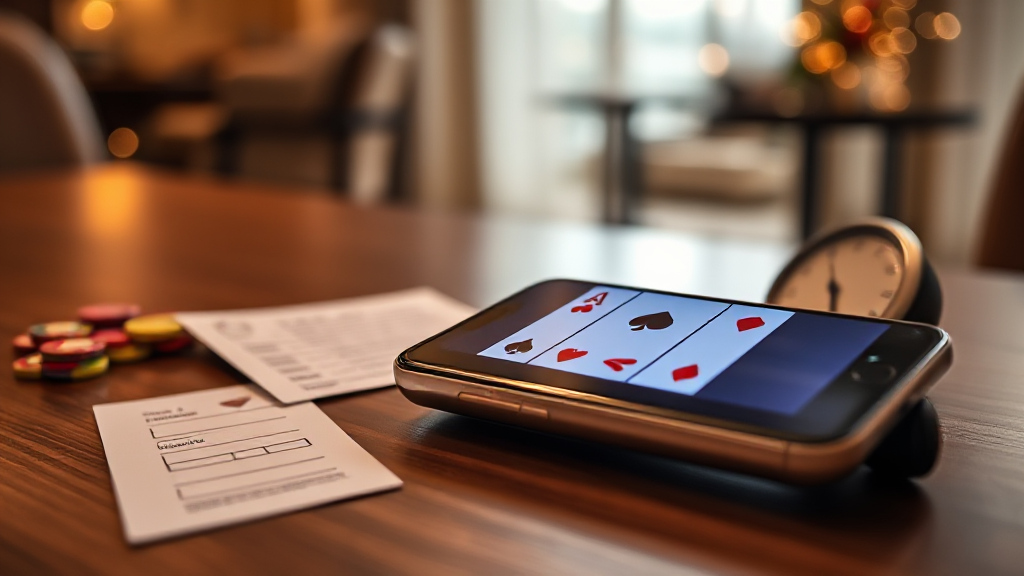
What Should You Prepare Before Your First Time Play Rummy Game?
Most guides about starting rummy jump straight into rules and card combinations. They skip the one thing that actually decides whether your first session feels calm or chaotic: preparation. Before you tap install or open a table, you need a small set of practical decisions already made. This article is written the way I would explain it to a friend who just asked me, “I want to try rummy on my phone — what do I do first?” The answer is not a list of card sequences. It is a short setup routine that removes friction, protects your time, and lets you focus on the game itself. If you are approaching your First Time Play Rummy Game, treat the steps below as your pre-flight checklist rather than a rulebook.
1. Decide Where You Will Play Before You Decide How
The single biggest mistake new players make is installing the first app they see and then trying to learn the game inside it. That reverses the order. You should choose your environment first, because the app you pick shapes how you learn: the tutorial quality, the table pace, the size of the buttons, and how clearly the interface explains each action all differ from one product to another.
Play Rummy Lane is a phone-first directory that helps users compare rummy apps on mobile, review bonus and withdrawal details, and check Android installation information before visiting third-party destinations. That kind of comparison page is genuinely useful at this stage because you are not yet loyal to any brand. You are simply trying to find a layout that makes sense to your eyes and thumbs. Look at screenshots, read what each app says about its interface, and note whether the app is designed primarily for phones or for larger screens. Since most first sessions happen on a phone, a mobile-first design matters more than a long feature list.
While you compare, pay attention to three things only. First, whether the app explains its own rules inside the interface. Second, whether the deposit and withdrawal information is stated plainly rather than buried. Third, whether the app clearly labels itself for adults 18+. If any of those three is missing or vague, move on. You have not started playing yet, so nothing is lost by being selective.
2. Set Your Device Up Properly
A first rummy session on a phone fails for boring technical reasons far more often than for strategic ones. The app closes mid-hand because a notification arrived. The screen dims because battery saver kicked in. The connection drops because you were on mobile data in a weak spot. None of these are game problems, but they all feel like game problems when you are new.
Before your first hand, do the following. Charge the phone above fifty percent. Turn on do-not-disturb so calls and messages do not cover the table. Connect to stable Wi-Fi if you have it. Close background apps that are heavy on memory. If you are installing on Android and the app is distributed outside the standard store, read the installation notes carefully and confirm you understand what permissions the app requests and why. A directory that lists Android installation information is helpful here because it saves you from guessing which file or setting you need.
Also decide where you will physically sit. Rummy on a phone rewards a stable position and two free hands. Playing while walking, cooking, or commuting sounds efficient and almost always produces a distracted, error-prone first experience. Give the game twenty quiet minutes instead of an hour of half-attention.
3. Learn the Shape of the Game, Not Every Rule
You do not need to memorise every variation before your first hand. You need to understand the shape of a turn. In the most common form, each player is dealt a set of cards, one card is placed face up to start the discard pile, and the remaining cards form the closed deck. On your turn you draw one card — either from the closed deck or from the open discard pile — and then discard one card. Your goal is to arrange your hand into valid combinations, typically sequences and sets, and to finish with a valid declaration.
That is the entire loop. Draw, arrange, discard. Everything else is detail you will absorb by playing. What matters before you start is that you can answer three questions without hesitating: How many cards am I holding? What counts as a valid sequence? What counts as a valid set? If you can answer those three, you are ready to sit down.
One more term is worth knowing before you begin: the difference between a pure sequence and an impure sequence. A pure sequence uses consecutive cards of the same suit with no substitute. An impure sequence uses a joker or a wild card in place of a missing card. Many beginners lose their first hand not because they played badly but because they declared with an invalid combination. Knowing this distinction in advance prevents that specific, very common mistake.
4. Understand What the Joker Actually Does
New players often treat the joker as a mystery. It is not. In most rummy formats, a joker is a substitute card. It stands in for a card you need to complete a sequence or a set. There are usually two kinds: the printed joker that comes with the deck, and the wild card joker determined at the start of the game by a randomly drawn card.
The practical rule for your first session is simple. Use jokers to complete combinations, but do not build your entire hand around them. A hand that depends on a single joker is fragile. A hand with one pure sequence already locked in is stable, because it cannot be broken by the rules of declaration. Aim for at least one pure sequence early, then use jokers to fill gaps in the rest of your hand.
This is also where a lot of first-time confusion about scoring begins. Points are usually counted against the cards still in your hand when someone else declares, and jokers are typically valued differently from face cards. You do not need to memorise the full points table before you play. You do need to know that an unarranged hand is expensive, which is why discarding thoughtfully matters more than discarding quickly.
5. Set a Time and Money Boundary Before You Start
This is the step most guides omit entirely, and it is the one that protects your first experience the most. Before you open the app, decide two numbers: how long you will play, and what you are willing to spend, if anything at all.
Write them down somewhere outside the app. A note on your phone, a piece of paper, anything that is not inside the game interface. The reason is straightforward. Inside the app, every element is designed to keep you engaged, and engagement is not the same thing as enjoyment. A boundary set in advance is easy to keep. A boundary decided in the moment is easy to negotiate away.
If you are playing a free or practice mode, the time boundary still matters. Twenty focused minutes teach you more than two distracted hours. If you are playing a format that involves real money, the spending boundary matters even more, and you should only ever use money you can comfortably afford to lose. Rummy apps are intended for adults 18 and over, and responsible play is not a slogan — it is the difference between a hobby and a problem.
Set a timer if you need one. There is no shame in it. Experienced players do this too.
6. Play Your First Hands in Practice Mode
Almost every rummy app offers a practice or free-play option. Use it. Not for five minutes as a formality, but for a full session. Practice mode exists precisely so that your first mistakes cost nothing.
While you are there, deliberately make mistakes. Discard a card you should have kept. Declare with an invalid hand and see what the app tells you. Try drawing from the discard pile and then from the closed deck so you feel the difference. The goal is not to win. The goal is to make the interface boring, so that when you play for real, your attention is on the cards rather than on which button to press.
This is also the right moment to test the withdrawal and account details you read about earlier. If the app shows you your balance, transaction history, or bonus terms, look at them now while nothing is at stake. Understanding how money moves in and out of the app before you need to know is far less stressful than learning it afterward.
7. Keep Your First Session Small and Short
When you move from practice to a real table, choose the lowest available stakes or the simplest available format. The point of your first real session is not profit. It is to confirm that you can complete the loop — draw, arrange, discard, declare — under mild pressure without losing track of your hand.
Expect to lose your first few hands. This is normal and it is not a signal that you are doing something wrong. Rummy is a game of incomplete information, and new players routinely misjudge which cards their opponents are collecting. Losing a small hand teaches you more than winning a large one, because you can trace exactly where your arrangement went wrong.
After each hand, ask yourself one question: did I have a pure sequence early enough? If the answer is no, that is your improvement target for the next hand. If the answer is yes, ask whether you discarded a card you later needed. Those two questions will carry you through your first several sessions better than any strategy article.
8. Know When to Stop for the Day
Decide in advance what a bad session looks like, and treat it as a signal rather than a challenge. If you have lost more hands than you can count, if you are no longer reading your cards carefully, or if you have passed the time boundary you set in step five, stop. Close the app. Come back tomorrow.
Stopping is a skill, and like any skill it improves with practice. Players who last in rummy are not the ones who never lose. They are the ones who lose small amounts and return with a clear head. Your first session should end while you still find the game interesting, not after you have stopped enjoying it.
Your Pre-First-Game Checklist
Before you sit down for your first hand, run through this list. It takes two minutes and saves hours of avoidable frustration.
Device ready: phone charged, notifications silenced, stable connection, background apps closed. App chosen: interface understandable, rules explained in-app, bonus and withdrawal details stated plainly, Android installation requirements checked if applicable. Rules understood: you can describe a turn, define a sequence and a set, and explain what a joker substitutes for. Boundaries set: a time limit and a spending limit, written outside the app. Practice completed: at least one full session in free-play mode. Stakes chosen: the lowest or simplest available format for your first real hands. Stop rule agreed: a clear condition for ending the session.
If every line on that list is ticked, you are genuinely ready. And if you are still deciding which app to open first, spend a little time comparing options on a mobile-friendly directory rather than installing on impulse — the ten minutes you invest in choosing well will shape every session that follows. Your first time playing rummy should be a small, controlled, mildly confusing, and ultimately enjoyable experience. Prepare for it properly, and it will be.